
Introduction
Choosing the right graphics card is crucial for maximizing your computer’s performance, particularly in gaming, video editing, and handling complex computational tasks. Whether building a new PC or upgrading your current system, the decision can be overwhelming with so many options available. This guide is designed to demystify the process, offering insight into understanding your requirements, evaluating specs, ensuring compatibility, and making budgeting decisions to guide you to an informed purchase decision.

Understanding Your Needs
A clear comprehension of your individual requirements is essential when choosing a graphics card. Knowing whether you’ll primarily use your system for gaming or professional applications significantly narrows down options.
-
Gaming vs. Professional Use: Gamers often need graphic cards that offer higher clock speeds and capable cooling solutions, with a focus on VRAM for smoothness in high-resolution gaming. On the other hand, professionals using 3D modeling or video editing software may require a GPU optimized for rendering and multitasking capabilities.
-
Resolution and Monitor Compatibility: Consider the resolution for your games or professional tasks. Higher resolutions like 4K demand more powerful graphics cards. It’s essential to ensure compatibility with your monitor’s refresh rate to facilitate seamless performance without graphical issues like screen tearing.
With a solid understanding of your needs, you’re ready to look at the different types of graphics cards available.

Types of Graphics Cards
The choice between integrated and dedicated GPUs is a fundamental decision, impacting performance and budget.
- Integrated Graphics vs. Dedicated GPUs: Integrated graphics come with the CPU and depend on shared system memory, becoming a cost-effective choice for general use. However, dedicated GPUs contain separate memory, delivering higher performance levels necessary for demanding tasks like gaming and professional workloads. If high performance is your target, dedicated GPUs are ideal.
Grasping these distinctions acts as a foundation for evaluating the critical specifications you’re about to encounter.
Key Specifications to Consider
Understanding the specifications of a graphics card is a critical step towards ensuring optimal system performance.
-
GPU Architecture and Cores: The GPU architecture affects how tasks are processed, with more cores generally equating to better performance. It’s beneficial to contrast the performance benchmarks between manufacturers like NVIDIA and AMD.
-
VRAM and Its Importance: Video RAM is essential for storing graphics data, with requirements fluctuating. For 1080p gaming, you might find 4-6GB of VRAM adequate, though 1440p and 4K gaming might demand 8GB or more. VRAM is critical for handling large textures and complex computations in professional tasks.
-
Clock Speed and Performance Metrics: Clock speed, noted in MHz, dictates how efficiently a GPU performs tasks. While higher clock speeds enhance performance, they also elevate power usage and heat output, highlighting the need for effective cooling.
Having clarity on these specifications leads you to ensure their compatibility with your setup.
Compatibility and Setup
Proper compatibility with existing system components is vital when selecting a graphics card. Addressing these factors preemptively avoids potential issues and maximizes performance.
-
Motherboard and PCIe Slot Considerations: Most GPUs require PCIe slots, and it’s vital that your motherboard has an appropriate one. Additionally, ensure it supports the card’s bandwidth capabilities.
-
Power Supply and Connectors: Confirm that your power supply can accommodate the graphics card’s power needs, verifying compatible connectors. Using a power calculator can help assess required wattage.
-
Cooling Solutions and Case Fit: Effective cooling solutions are necessary as GPUs generate considerable heat. Ensure that your PC case can accommodate the card’s dimensions as some advanced GPUs necessitate space for complex cooling solutions.
Once the compatibility is assured, it’s time to align these components with your budget.
Budgeting for Your GPU
Budgetary constraints often guide the choice of graphics card, helping to prioritize features fitting your needs.
-
Entry-Level to High-End Options: Entry-level cards cater to basic tasks and casual gaming, middle-range models deliver improved performance for modern titles, while high-end GPUs, although costly, provide unmatched performance for gaming and demanding professional tasks.
-
Cost vs. Performance Trade-offs: It’s indulgent to splurge on high-tier models, yet understanding your performance needs against your requirements ensures optimal value for your investment. Keeping an eye out for discount periods and promotions can yield high returns on your investment.
Finding this balance naturally paves the way for comparing models and brands on the market.
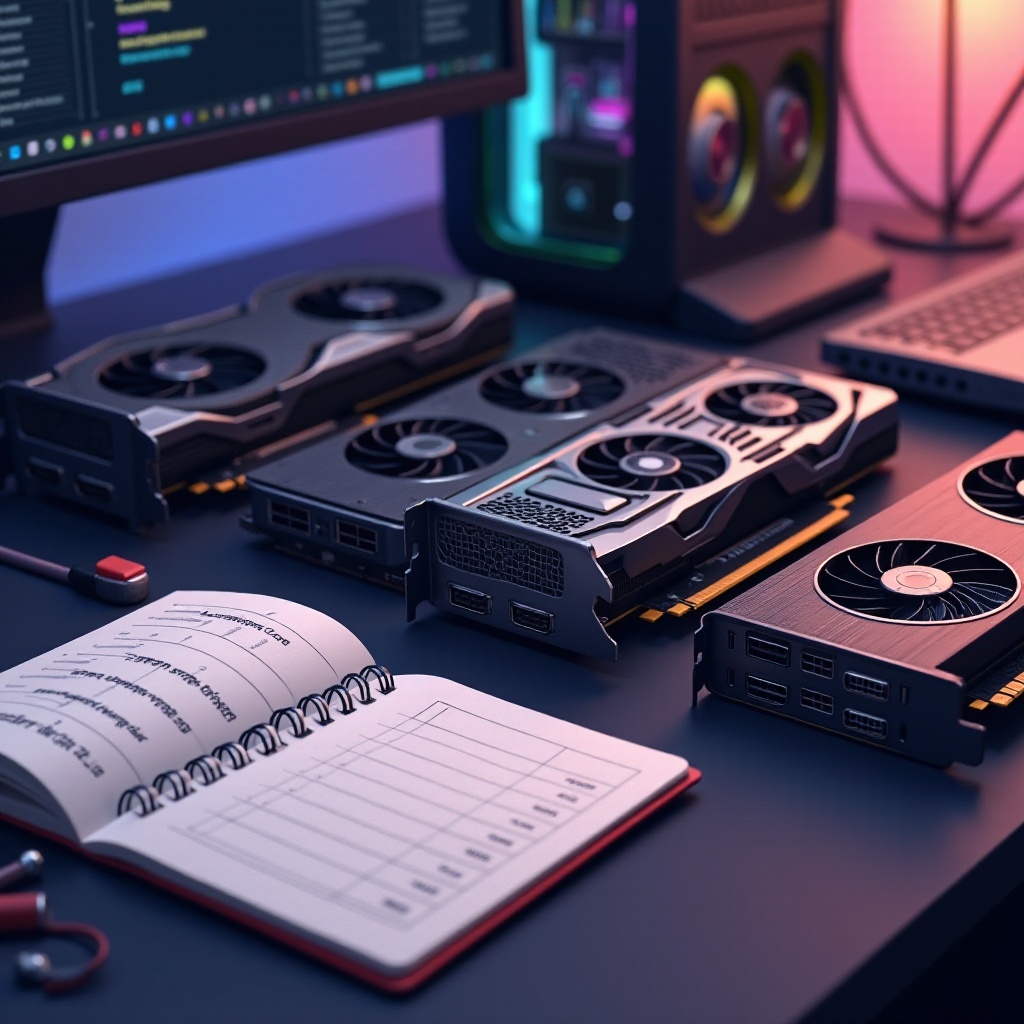
Brand and Model Comparisons
The graphics card market is dominated by several key players, each with unique offerings.
-
Overview of Major Manufacturers: The main contenders, NVIDIA and AMD, each bring different strengths to their GPUs. NVIDIA’s cards are renowned for their ray tracing technology, while AMD is lauded for its competitive pricing and multi-monitor capabilities.
-
Evaluating Specific Models and Variants: After choosing a brand, comparing specific models becomes pivotal (e.g., NVIDIA’s RTX series vs. AMD’s Radeon series). Examine expert reviews and user feedback to identify a model aligned with your requirements.
Considering these elements should lead you to a confident and sound purchasing decision.
Conclusion
Making an informed choice about your graphics card involves comprehending your computing needs, examining GPU types, evaluating specifications, ensuring system compatibility, and smart budgeting. Equipped with this knowledge, you ensure an informed selection that enhances your computing capabilities.
Frequently Asked Questions
What is the difference between integrated and dedicated graphics cards?
Integrated graphics reside in the CPU, sharing system memory, ideal for basic tasks. Dedicated graphics have independent memory, providing superior performance for intensive tasks.
How much VRAM do I need for gaming in 2024?
For 1080p gaming, 4-6GB of VRAM usually suffices. However, for 1440p or 4K gaming, at least 8GB of VRAM is recommended to ensure smooth performance.
Can I upgrade my laptop’s graphics card?
Upgrading laptop GPUs is typically not feasible due to space constraints. Some laptops support external GPUs (eGPUs) for enhanced performance if needed.